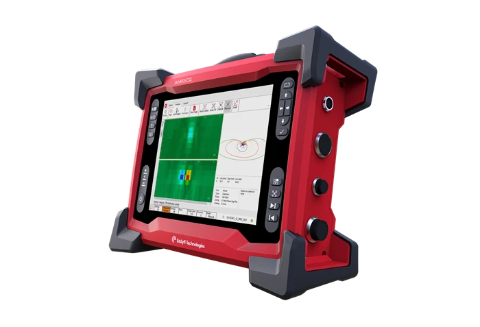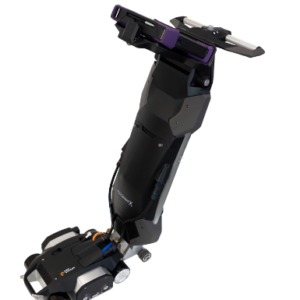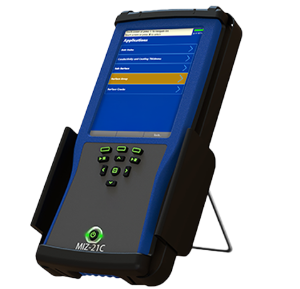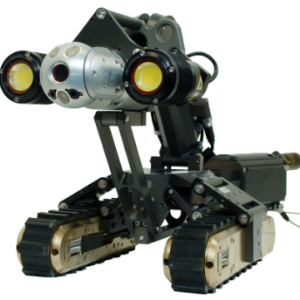
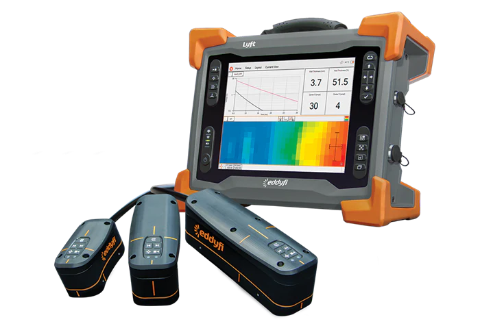
• State-of-the-art portable and connected instrument
• Inspect through thick insulation and fireproofing
• Save on insulation removal costs
• Real-time imaging for instant results
• Unrivalled productivity with PECA
• Easy setup with SmartPULSE™ calibration
• Highest confidence with Tau-scan™ and PermTool™ advanced analysis tools
INSTRUMENTS
Dimension (W × H × D)
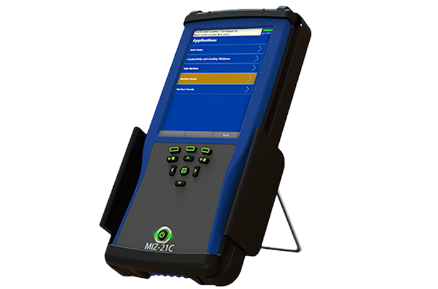
355 × 288 × 127-mm (14.0 × 11.3 × 5.0-in)
Instrument weight
6.6 kg (14.5-lb)
Number of channels
7 (GDA)
Display
– 26.4-cm (10.4-in)
– Multi-touch
– Non-reflective (AR coating)
– Anti-fingerprint (oleophobic coating)
– 3-mm (0.125-in), chemically strengthened glass cover
– Optically bonded LCD and touchscreen
– Passive blacklight enhancement
Connectivity
Gigabit Ethernet, Wi-Fi™, Bluetooth®, 3 × USB 2.0
PERFORMANCE
Dynamic data acquisition
Up to 15 points/s
Dynamic scan speed
75-mm/s (3-in/s) (Typical), subject to variations based on component specifications and acquisition parameters.
Grid mapping scan speed
Instant, less than 1 second (typical)
SmartPULSE
– Automatic configuration of PEC pulser-receiver parameters
– Full thickness sensitivity (OD and ID flaw detection)
– Reliable measurements even with liftoff variations, weather jacket overlaps, straps, and corrosion scabs
– Repeatability optimization
– One-point calibration (on nominal wall or known thickness value) and auto-normalization
PROBES
Features
– Remote control keypad
– Lyft 27-pin Fischer connector
– Heavy-duty 5-m (16.4-ft) cable
– Support for universal clip-on encoder
Nominal wall thickness
Up to 102-mm (4-in)
Insulation (Liftoff)
– PECA-6CH-MED: 0–102-mm (0.4-in)
– PEC-152G2: 0–305-mm (0–12-in)
– PEC-089-G2: 0–203-mm (0–8-in)
– PEC-025-G2: 0–76-mm (0–3-in)
Smallest detectable defect volume
15% of footprint volume (footprint × wall thickness)
Min. measurable remaining wall thickness
15% from nominal
Weather jackets
– Stainless steel up to 1.5-mm (0.06-in)
– Aluminium up to 1-mm (0.04-in)
– Galvanized steel up to 1-mm (0.04-in)
Pipe diameters
Down to 25-mm (1-in)
Test temperatures
– Carbon steel structure temperature range: -150–500°C (-238–932°F)
– Maximum weather jacket temperature for direct contact operation: 70°C (158°F)
– Maximum weather jacket temperature with probe shoe: 120°C (248°F)